7 things nobody tells you about toddler shoes — and the 4-second test that shows you all of them
Their feet are still forming. Most toddler shoes are adult shoes shrunk down. Here's what's worth knowing before the next pair.
By
Nina Jansen
, Tiny Explorings
·
Updated
September 2026
·
4 min read
A toddler's foot is widest right at the toes. Almost no shoe on the shelf is.
Most of us buy toddler shoes the way we buy our own: we check the length, we check they look nice, and we check they're not falling apart. Nobody tells you to check whether the shoe bends, or whether the front is wide enough for the toes to sit flat.
Which is a shame, because those two things do more than everything else on the box combined. Here are seven, and two quick tests you can do at home with the pair they're wearing right now.
01
Your toddler's feet are 75% cartilage
An adult foot is bone. Your toddler's is about 75% cartilage — the 26 bones inside it haven't fused yet. Soft, still forming, and taking the shape of whatever it spends the day inside.
That's not a reason to panic. It's a reason to look at what they're in for ten hours a day, which most of us never do.
02
There are 7,000 nerve endings in each foot
Seven thousand, in a foot the size of your palm. Every step sends information up — what the surface is, where the edge of the rug is, how they're balanced.
Everything you put between that foot and the ground is something they don't get to feel. A thick, padded sole feels lovely in your hand in the shop. On the floor, it's the volume turned down.
Test 1 — four seconds
Hold the shoe they wore today in both hands and try to fold it heel to toe. If your hands can't bend it, their foot can't bend it either.
The test takes six seconds and you can't un-see it.
03
Toes are supposed to spread — most shoes stop them
Watch a barefoot toddler walk and you'll see the toes fan out on every step. That splay is the foot doing its job.
Then look at almost any toddler shoe: it narrows to a point at exactly the place their foot is widest. One foot specialist put it at roughly 70% of children wearing shoes too narrow for them — and it's the one thing almost nobody checks.
Test 2 — six seconds
Pull the insole out, put it on the floor, and stand them on it. If their toes hang over the edge or curl in to fit, that's your answer.
Anniversary deal · Ends today
Tiny Explorings sock shoes
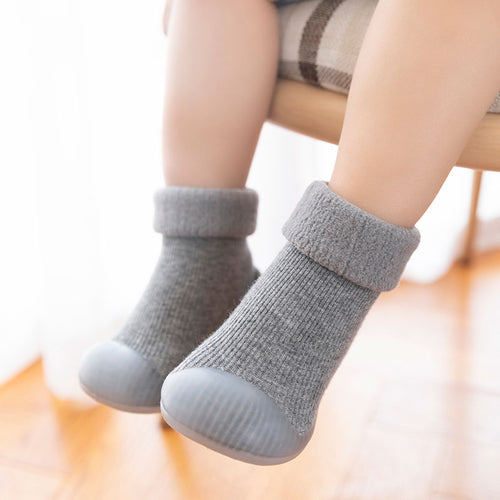
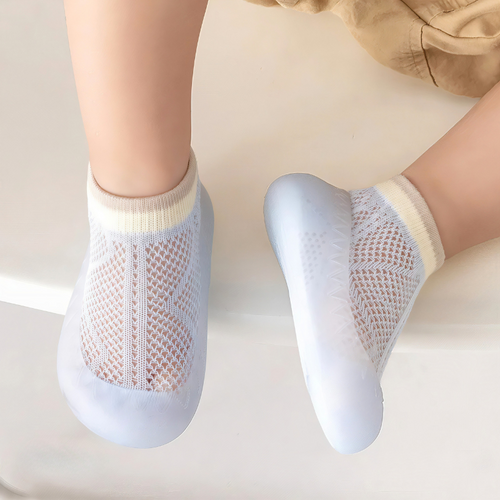
A 3mm sole that folds heel to toe. A wide toe box. 100% cotton lining. Goes on like a sock and stays on.
"Supportive" usually means the shoe is doing the work
It's the word on every box, and it sounds like the thing you want. But support means the shoe is holding the foot in a shape — doing the job the foot is supposed to be learning to do itself.
A first walker isn't weak. They're new. What they need is room, grip and the ability to feel where they are.
"She falls on flat floor and you think she's clumsy. She isn't — she's learning balance with the volume turned down."
100% cotton on the right. Synthetic mesh on the left, which is what most of them are.
05
100% cotton — not cotton blend, not mesh, not foam
Feet sweat more per square inch than almost anywhere on the body, and whatever is lining that shoe sits against their skin for ten hours a day.
Most toddler shoes are lined with synthetic mesh or foam, because it's cheap and it photographs well. Ours is 100% cotton — the whole inside, against the whole foot, with nothing synthetic in between.
Turn yours inside out tonight and read the label. It's the one material nobody checks, and the easiest one to get right.
06
A shoe that fits gets worn — and the morning fight ends
The twenty-minute battle at the front door is usually information. A shoe that pinches at the front and won't bend is a shoe a toddler will take off in the car.
These go on like a sock — one motion, two seconds, no velcro. Most parents tell us the same thing within a fortnight: they put them on themselves now.
3mm flexible soleWide toe box100% cotton liningGrippy rubber outsoleMachine washable
07
They'll outgrow them either way
Toddler feet grow fast, which is the argument people use for buying cheap and the argument people use for buying a size up. Sizing up is the worse of the two — the empty toe catches the floor on every step.
Buy the size they are, in something that bends, and wash them instead of replacing them. Muddy shoes go in the machine and come out fine.
If you only do one thing
Go and get the shoes they wore today. Fold them heel to toe. Pull the insole out and stand them on it.
Whatever you buy next — ours or anyone's — those two tests are the whole checklist.
Anniversary deal · Ends today
Built around the two things that matter
3mm flexible sole · wide toe box · 100% cotton lining · goes on like a sock · machine washable
90-day money-back guarantee. If they're not right, send them back.
Questions we get a lot
They look so thin. Do they need more support than that?
Support means the shoe is doing the work their feet should be learning to do. The sole is thin, not missing — there's a grippy rubber outsole underneath it.
Can they wear them outside?
Yes. Tarmac, grass, puddles, the playground. Then in the washing machine.
What if I get the size wrong?
The knit upper is forgiving, and there's a 90-day money-back guarantee. Sizing guide is on the product page.
What age are they for?
First steps through to around five, up to size 30.